
.png)
As part of an Erasmus+ project, ICES is hosting two Ukrainian students on academic mobility during the spring semester of 2026.
During the International Week organized on Campus from March 2nd to 5th, the students shared typical aspects of Ukrainian culture (paintings, music, pictures of emblematic places) with French and international students.
We interviewed Zlata about her mobility experience at ICES halfway through the semester.
Interview transcript
Can you introduce yourself and tell us about your university in Ukraine and your field of study?
My name is Zlata-Yaryna Matsko. I come from Kharkiv, which is based in the eastern region of Ukraine, and I study at the Ukrainian Catholic University (UCU) in Lviv, a city based in the western region of Ukraine. I am currently in my third year of study out of four years (undergraduate degree), and my field of study is History, with a specialization in the 80’s and 90’s in the Soviet Union. My classes are in Ukrainian and English.
What motivated you to apply for this exchange program?
I wanted to have a study experience in Western Europe, either in Germany, France or Ireland. As I have already experienced Ireland before, and I have been learning French in high school and at my university, I decided to prioritize France. Before this mobility experience I had an A2 level in French. My university has several partnerships in France. Paris was not available for this semester, and I did not want to go to the North of France because of the weather, so I chose the closest option to the sea at La Roche-sur-Yon.
What were your first impressions when you arrived on ICES campus?
My first contact was with Anastasiia’s buddy from Globo association, Mathilde. When we arrived in La Roche-sur-Yon, it was snowing and our student residence was not accessible, so she was really kind and let us sleep at her place and we could taste brioche with salted-butter caramel.
The town and campus here are much smaller than my home town and university. But I was happy to find a common catholic culture (statue of Mary). I was surprised by the need to use a badge at the entrance of the campus, I do forget mine quite often. At my home university, we have a security person at the entrance to check suspicious people.
How would you compare your learning experience here with your home university?
There are totally different learning systems. In Ukraine, we have to read books and documents alone before class, and during class we spend time discussing it. In France, it’s mainly about listening to the teacher during the class, and maybe asking a few questions, but we are more passive in history of political science class. A bit less in French as a Foreign Language. Here we rarely have breaks to drink water or go to the bathroom.
Is there an activity that has been particularly meaningful to you here? Why?
I met a lot of good people during class or through Globo association, and now I have this group of friends that I meet regularly outside of class and outside of campus to play the piano or go bowling for example.
How has this mobility experience contributed to your personal or academic growth?
I am becoming more autonomous from living alone in a foreign country, doing things by myself. I heard that in France nobody wants to speak English but that’s not true, it’s a stereotype. I discovered that I don’t like coffee here, I prefer the coffee in Ukraine.
What aspects of Ukrainian culture do you enjoy sharing with other students here?
I was very surprised that many people here don’t know well the difference between Russian and Ukrainian culture, and that they are not very aware of the current situation in my country.
Ukrainian culture right now is related to war a lot, actually it has been part of my life since I was 7 years old because I live close to the Russian border. I am 19 now. I explain what’s going on and how we are resisting in Ukraine, and I also give visibility about my country in general because we don’t like being compared to Russians. Ukraine is a big country with 40 million inhabitants. I would like to see more support for Ukraine in La Roche-sur-Yon and at the university.
What aspects of campus life or student culture have you enjoyed the most?
It happens very often that students here will invite each other at their home to cook or play games in small gatherings. We don’t have this culture in Ukraine, students usually meet outside to party, we would only invite people in our home to celebrate a birthday for example. It’s nice.
In a few words, how would you describe your mobility experience so far?
In general I enjoy my experience here. I would like to be more challenged academically though, with more interaction in class. And the town is quite small so I am interested in visiting bigger towns.
Apart from la Roche-sur-Yon, where have you been in Vendée Region, France and Europe?
I have already visited Paris, Marseille and Les Sables d’Olonne. And soon I will be visiting the Brittany region and Barcelona.
What is your favorite place in La Roche-sur-Yon?
Near my student residence there is a park with a small river and some benches. I go there to read books, it’s nice and quiet.
What is your favorite word or sentence in French?
I just learned it in French class: “il n’y en a pas”. It’s very practical and sounds funny at the same time. I also like the expression “foufou”, it’s a good word to describe my friends and I.
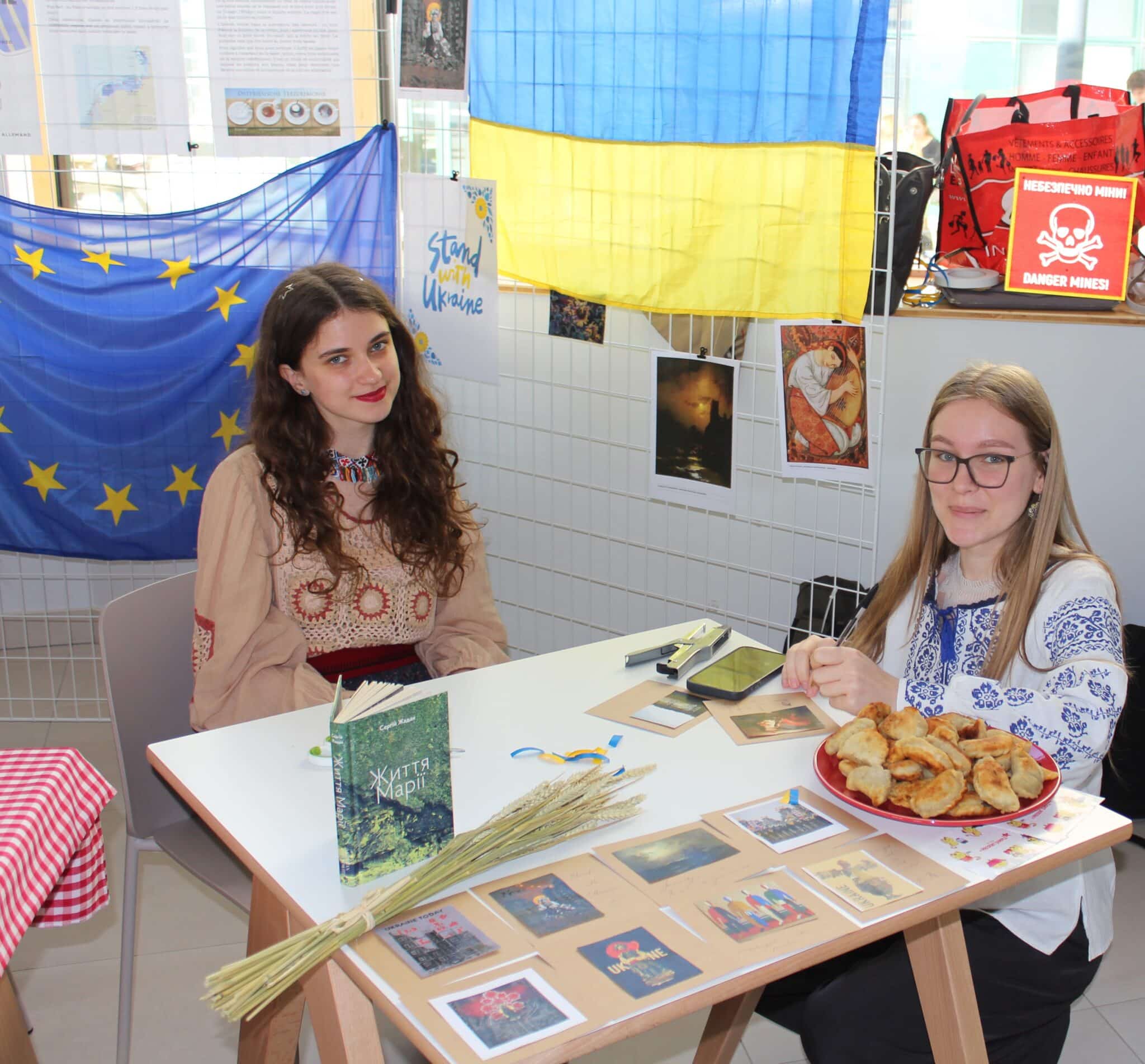
Zlata and Anastasiia holding the Ukrainian stand at the International Week
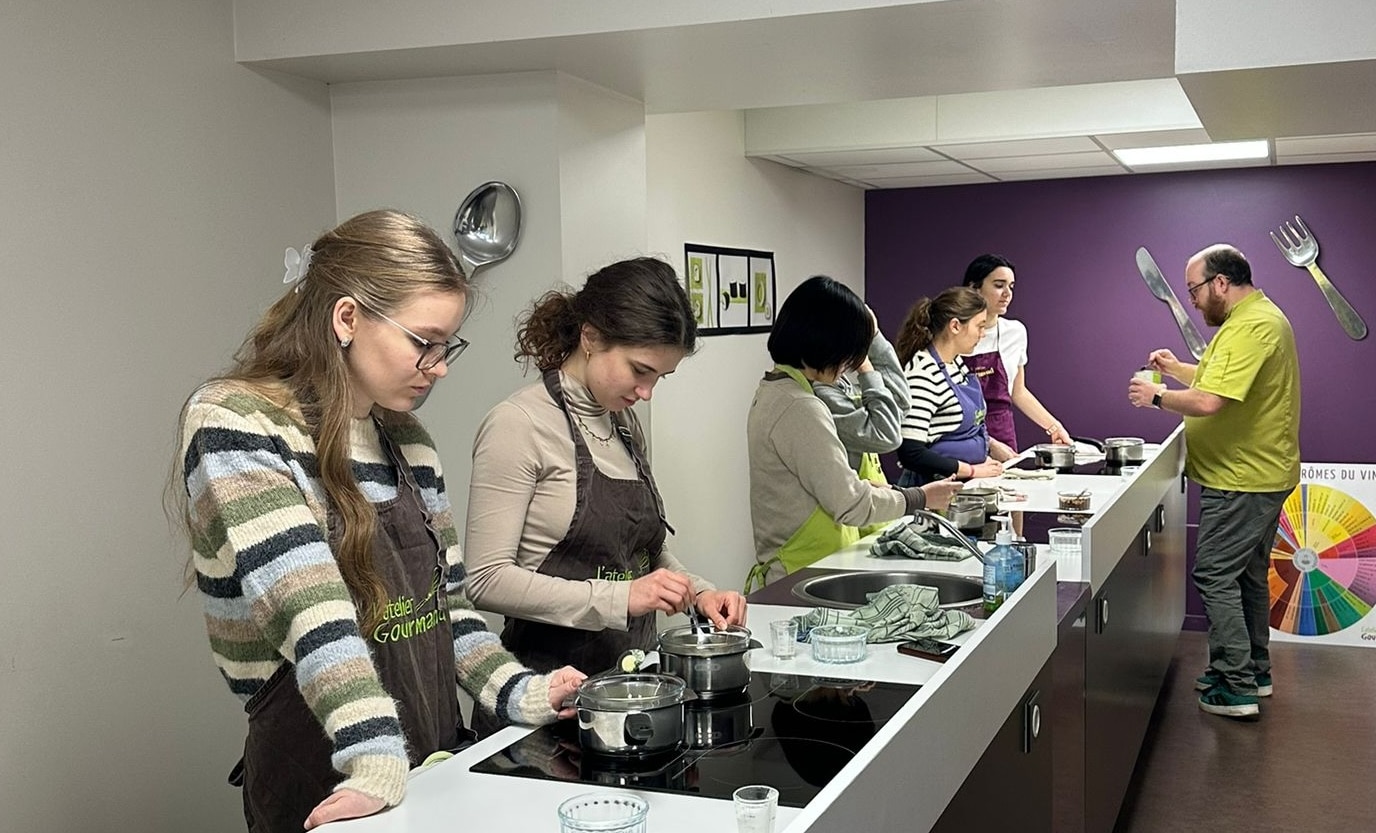
Anastasiia and Zlata baking during the Welcome Seminar

Park "La Vallée Verte" in La Roche-Sur-Yon