.png)
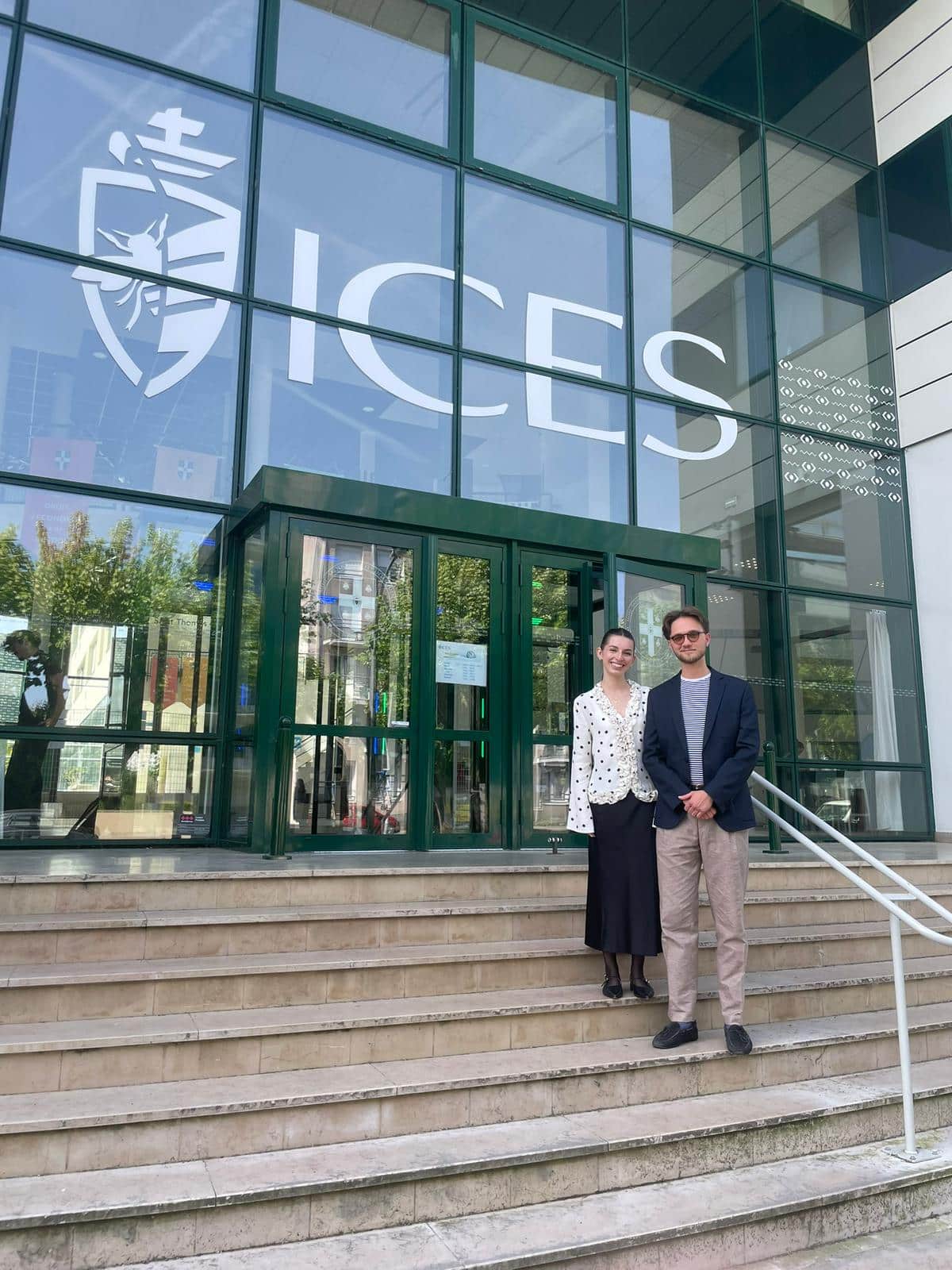
ICES is hosting two Polish students on academic mobility during the spring semester of 2026.
The Catholic University of Vendée has multiple partner universities across Poland. For the first time, we are hosting 2 students from the University of Silesia in Katowice.
They share their impressions about their experience in La Roche-sur-Yon and at ICES.
Interview transcript
Can you introduce yourself and tell us about your university in Poland and your field of study?
Stanislaw:
My name is Stanislaw Jozef KONDERA, I am a student at the University of Silesia in Katowice, Poland. I am currently pursuing a Bachelor degree in interdisciplinary studies, my major is “International Studies in Political Science and Diplomacy”, and my main fields of interest are History, International Relations, Colonialism, and Politics in the Balkan region.
Julia:
My name is Julia RAJNYSZ, I am studying at the same university as Stanislaw, and my field of study is also “International Studies in Political Science and Diplomacy”.
What motivated you to apply for this exchange program?
Stanislaw:
I decided to come to France because I like this country. Poland has a lot of historical connections with France. I started to learn French in high school as an extra-curricular course. Our current French professor in Poland recommended us to come to ICES because it’s easier to connect with French people and to understand the culture in smaller cities like La Roche-sur-Yon. We are the first students from our university coming to ICES.
Julia:
I started French lessons 2 years ago at the university because I want to work in Diplomacy in the future. It’s not an easy language, so I thought the best way to improve is to come to France and practice with native people. I didn’t want to go to a big city like Lille or Bordeaux because you can meet a lot of international people there, so the risk is to speak more English than French.
What were your first impressions when you arrived at La Roche-Sur-Yon and at ICES?
Julia:
The city is well connected in terms of trains and roads, even if it’s located in the Western part of France and close to the sea. We came by car from Poland, it took us 3 days but we don’t regret it. As car-pooling is considered “green mobility” by Erasmus+, we received extra money. In daily life, it’s really practical to buy groceries. We usually drive to Lidl because we also have this supermarket in Poland so it’s familiar.
When we arrived on the first day, it was snowing. I was surprised by the shock of French people, they had trouble driving and many shops were closed. I did not expect this, because this situation is so common for us, it was -15°C when we left Poland.
Academically, I was positively surprised by the large amount of French language courses (6 hours per week). It is so helpful to understand the students and all the other courses we have here. It helped me to become more confident in my interactions. Also the French language professors are really welcoming and kind.
Stanislaw:
I was surprised by the colours in the city, even during winter the trees and grass were very green. At ICES, I was impressed by the great organization around our arrival and the nice welcome. Some of our friends had problems with their accommodations on the first days but their buddies were very supportive and helped them. It showed us that there are strong values shared with our home university and country in this private and catholic university. It helped us to connect quickly with ICES students.
How would you compare your learning experience here with your home university?
Julia:
At ICES, we attend classes led by professors coming from multiple professional environments, for example ex-ambassadors, parliament members, etc. It’s interesting because they can teach from their own experiences, not only from books or research fields. They also come from all around the world (USA, Greece, etc.) so we discover different styles of teaching. Some French students are surprised that they are expected to interact with the professors during class because in France they are usually listening and taking notes. In Poland, we have to read books before class, and then we discuss it with the professor.
Stanislaw:
Regarding French language courses, we are very focused on gaining soft competences and practicing real life situations. I was missing the grammatical aspects that we were studying a lot in Poland, so I opened up to my French professor about this, and she was very open-minded, and she adapted the content of her class to include it as well. I was thankful that she took my request into consideration.
Is there a course, project, or activity here that has been particularly meaningful to you? Why?
Julia:
For me, it’s the French language course with Mrs Magali PAPIN. She creates a caring atmosphere in class, and she really believes in our capacity to improve fast. I used to be scared to speak French and to make mistakes, but she gave me the confidence I needed. We learned a lot about the French educational systems, and we worked on a project for applying to a seasonal job : write a CV in French, prepare for an interview. It was a fun way to learn.
Stanislaw:
I loved the course about “Eastern Mediterranean Politics” given by Mr. Michail SARLIS, it was very well-rounded and connected to my interest, I was very satisfied about it.
In French language courses, we were able to cover a lot of various topics including political aspects, industry, culture, and even the French Overseas Departments and Territories which is a topic we rarely discussed in Poland.
On a more personal level, we are very grateful for the support provided by Mrs. Aurélie PASQUIER from the International Relations Office. We were in touch before our arrival and she was the one helping us to find an apartment very close to the campus, and answering all our questions. With her support and the help of Globo association, we were also able to visit the theme park Puy du Fou for an attractive price, and all the practical aspects were managed, so we just had to sit in the bus and enjoy this incredible experience. It was very impressive.
How has this exchange experience contributed to your personal or academic growth?
Julia:
In class, I became more confident to speak in general, I learned there is no such thing as a wrong answer. On the personal side, I discovered that I am quite attached to following rules like being punctual, crossing the street at crosswalk or when the traffic light is green, queuing, etc. French people really appreciate life, for example they take long lunch breaks and they arrive late in class. I love France, but I get frustrated by this lack of order sometimes.
Stanislaw:
I am more strict when I am in Poland. I learned to be more relaxed in La Roche-sur-Yon. Everybody smiles and says “Bonjour” in the street. I feel there is less pressure to be perfect all the time here. I was surprised the first few weeks, because we barely had courses outside French language class so we did not know how to manage our time. But we adapted well, now we even enjoy a ride at the beach after class since it’s close by.
What aspects of campus life or student culture have you enjoyed the most?
Julia:
Thanks to Globo association and BDE (student union) , we met other international students and French students easily during diverse activities and parties, so we were able to enjoy student life.
Stanislaw:
I liked that students at ICES have common values and that they were so welcoming.
In a few words, how would you describe your exchange experience so far?
Julia:
It's the best experience of my life. I think everyone should experience academic mobility abroad. We made friends for life from diverse countries. We tasted great food. I was able to leave my comfort zone in a safe environment, and to become more independent because I had to figure out things by myself. It was less scary because we are experiencing this together.
Stanislaw:
It’s great, the level of education at ICES is very professional, people are nice and smile a lot, and the climate is great with a lot of sun. The meat is really good as well.
What’s your favorite word or sentence in French?
Julia:
“C’est la vie”.
Stanislaw:
"C'est mignon” and “chouette”.
What aspects of Polish culture do you enjoy sharing with other students here?
Julia:
We were happy to share our Catholic traditions. We invited our South-Korean and Hungarian friends for a traditional brunch on Easter. We were proud to share our culture.
Stanislaw:
We faced some stereotypes with our neighbors when we arrived. They thought that there is no electricity in the countryside in Poland, that the streets are dangerous in the cities, or that we speak Russian as a main language. We explain that Poland is a developed and civilized country, we share our reality and also details about our history. Maybe our experience in France made us a bit prouder of our country, but we also ensure that we integrate well wherever we go.
What is your favorite place in La Roche-sur-Yon?
Julia:
ICES library, I spend a lot of time studying. But I also love Les Sables d’Olonne, which is very close to La Roche-sur-Yon to enjoy the beach.
Stanislaw:
In La Roche-sur-Yon, I like to walk at the park “La Vallée Verte”. It’s close to the Yon river, it’s sunny and there are some benches to read a book. I also like the castle “le Château des Oudairies”. I really like Les Sables d’Olonne as well.
Apart from la Roche-sur-Yon, where have you been in Vendée Region, France and Europe ?
Julia:
We have been to many places in France : Les Sables d’Olonne, Nantes, La Rochelle, Bordeaux, Arcachon, la Dune du Pilat, Bayonne, Hendaye. We also visited San Sebastian in Spain, and Morocco twice : Marrakech, Casablanca, Rabat and the Atlas mountains.
Stanislaw:
Now that we have visited the South-West of France, we would like to travel more to the North-West side and visit Angers, Normandy with Mont Saint Michel, and Brittany.
What would you say to other international students who are considering ICES for their future mobility?
Stanislaw:
Before coming, I had read some press articles that were giving a conservative image of ICES, and I was a bit afraid that this would be a very strict environment, but in reality it’s not the case at all. People are open-minded and welcoming. If there is an opportunity to come back during my master degree, I would be really happy to study here again.
Julia:
Don’t think twice and go study at ICES ! The courses are interesting, you get the opportunity to meet great people, and the Vendée region is beautiful. It’s a great location to talk to French people easily, more than in big cities. And it’s a great starting point to visit France.